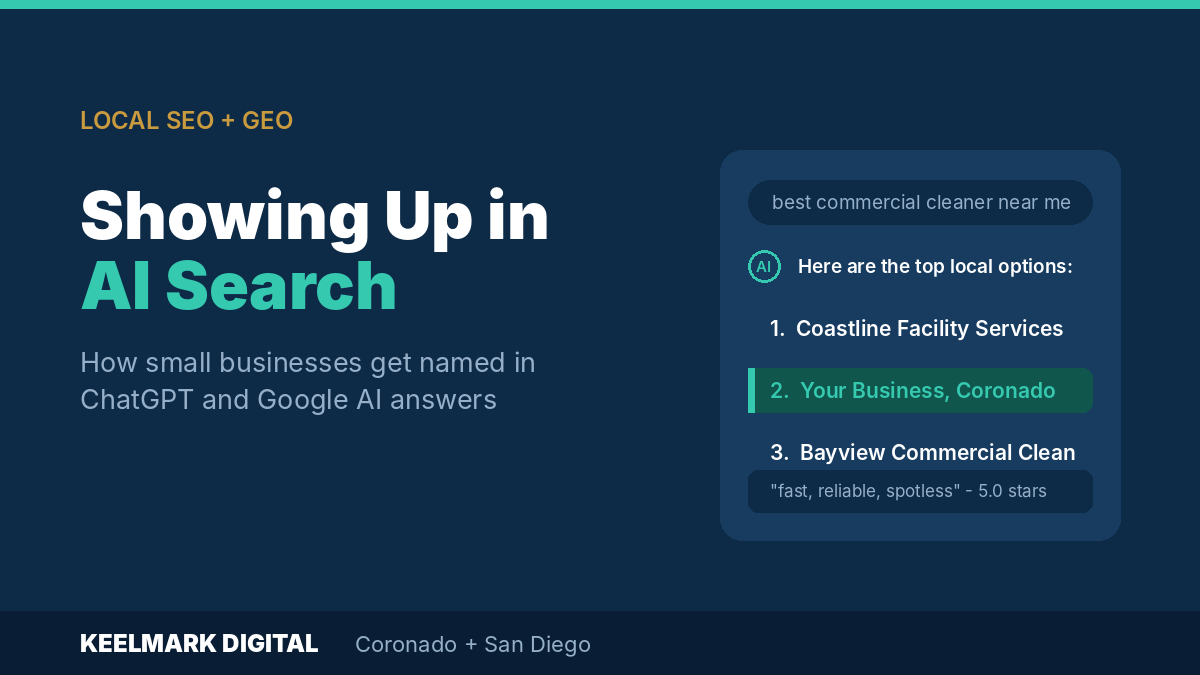
More and more, people do not scroll a list of ten blue links anymore. They ask a question and read the answer. They type “best commercial cleaner near me” into Google and get an AI summary at the top. They ask ChatGPT “who should I call to redo my restaurant’s website in Coronado” and get a short list of names. The search box is quietly turning into an answer box, and that changes one thing for every small business: you are no longer trying to rank on a page, you are trying to be the answer.
The good news is that there is no secret trick to it, and you do not pay to be included. Showing up in AI answers runs on the same foundations as showing up in local search, done properly. If you have those in place, the AI tools tend to find you and recommend you. If you do not, they skip you, and you never see it happen.
What is actually changing
Three things are worth understanding, without the jargon.
Google now puts an AI Overview at the top of many searches, a few sentences that answer the question directly and name a handful of businesses. It is built from the same local signals Google already trusts, and it can even quote lines from your reviews. ChatGPT, Perplexity and the other assistants do something similar when someone asks for a recommendation: they pull from what they can find about you across the web and hand the user a short, confident answer. And because ChatGPT’s search leans on Microsoft’s index, your Bing listing suddenly matters as much as your Google one.
The common thread is that these tools are not making things up about local businesses. They are repeating what the web already says about you, in the most consistent and credible version they can assemble. Your job is to make that version complete, accurate and easy to find.
How to show up in AI answers
Get your Google Business Profile right
This is still the single biggest lever for local AI results, the same way it is for the map pack. Pick the most accurate primary category, fill in every service you offer, keep your hours and service area current, add real photos, and answer the questions people post. A thin or half-finished profile is the most common reason a business gets left out of the answer. We walk through the mechanics in How to Show Up in the Google Map Pack.
Earn reviews, and reply to them
AI answers lean on reviews heavily, and Google’s AI Overviews will even pull a specific sentence from one. A steady stream of recent, detailed reviews tells both the algorithm and the next customer that you are the real thing. Ask happy customers at the moment the work is done, make it a habit, and reply to every review, good or bad. Volume and recency both matter.
Say the same thing everywhere
An assistant trusts the version of you that is consistent across the web. Your name, address or service area, and phone number should match exactly on Google, Bing, Apple, Yelp, your website and the big directories. Mismatched or outdated listings make the AI unsure, and an unsure assistant leaves you out. This is the quiet, unglamorous work that decides a lot, and it is a core part of local SEO.
Put the answers on your website in plain words
The assistants can only repeat what they can read. If your site clearly states what you do, where you do it, and who you do it for, in plain sentences rather than vague taglines, you give them something to quote. Pages that answer real customer questions, with the service, the service area and the specifics spelled out, are the ones that get picked up. Clean, fast, well-structured pages help here too, which is one more reason site speed and Core Web Vitals are worth getting right.
Be findable and consistent, not loud
There is no ad to buy and no code to paste that forces you into an AI answer. You get there by being the clear, consistent, well-reviewed, easy-to-read choice across the places these tools look. That is earned over weeks, not bought in a day, which is good news for the business that does the work and bad news for the one hoping for a shortcut.
A quick reality check
You do not need to chase every new AI tool or obsess over which one is winning. They largely draw from the same well: your Google Business Profile, your reviews, your listings and your website. Get those four right and you are in good shape across all of them at once. Google has said as much in its own guidance on AI features and your website: there is no special markup that buys your way in, just solid, helpful, well-organized information.
If you want to know where you stand today, the honest first step is to go ask. Open ChatGPT or Google and search the way a customer would, for what you do and where you do it, and see whether your name comes up. If it does not, that is not a verdict, it is a to-do list.
One newer step worth taking now: ChatGPT lets you claim your business directly and control what it says about you. See our step-by-step walkthrough on how to claim your business on ChatGPT.
Why work with a local, veteran-owned shop
We are Keelmark Digital, a veteran-owned web design and management studio based in Coronado and serving businesses across San Diego. Getting found in AI search is a real part of what we do now: we dial in the Google Business Profile, line up the listings, build the reviews habit, and make the website say clearly what you want the assistants to repeat. If you are not sure whether AI is sending customers your way or sending them to someone else, that is worth a short conversation. Start a project and we will take an honest look at where you show up and where you do not, no pressure.
